3 min read
How I built Aria: an inventory app with an AI voice assistant
The story of Aria, the custom inventory app running a restaurant's stock in Mantua, Italy: the problem, the technical choices, the voice assistant built with Claude and ElevenLabs, and what I learned.
- Business software
- Artificial intelligence
- Case study
Anyone who works in a restaurant knows the stockroom never stops. Deliveries arrive, supplier prices change, something runs out earlier than expected, and at the end of the month there's a stocktake to do by hand. At Scaravelli, a restaurant in Mantua, Italy, all of this lived across spreadsheets, supplier price lists and paper counts.
That's where Aria came from: a custom inventory app with a voice assistant you simply talk to. In this article I explain how I designed and built it, the choices I made and what I learned.
The problem: too many spreadsheets, too many prices to re-check
The starting point wasn't "let's put AI somewhere". It was much more concrete:
- product prices had to be re-checked every time, because price lists change;
- every stocktake took hours of counting and copying by hand;
- data was spread across several files, so it was hard to see the total stock value at a glance.
Off-the-shelf software would have solved part of the problem, but it would have forced the staff to change their habits. I chose to build a tool around the way they already work.
The catalogue: 5,300 products and 60 suppliers
The first step was getting the data in order. I built the catalogue from a dataset of about 5,300 products and 60 suppliers, with a price history for every item. When a price changes, the app knows and updates it automatically in stocktake sessions too.
On top of the catalogue there's a dashboard with items moved, stock value at purchase price and categories, plus an inventory table with search, filters, export and camera support.
The voice assistant: talking to the app
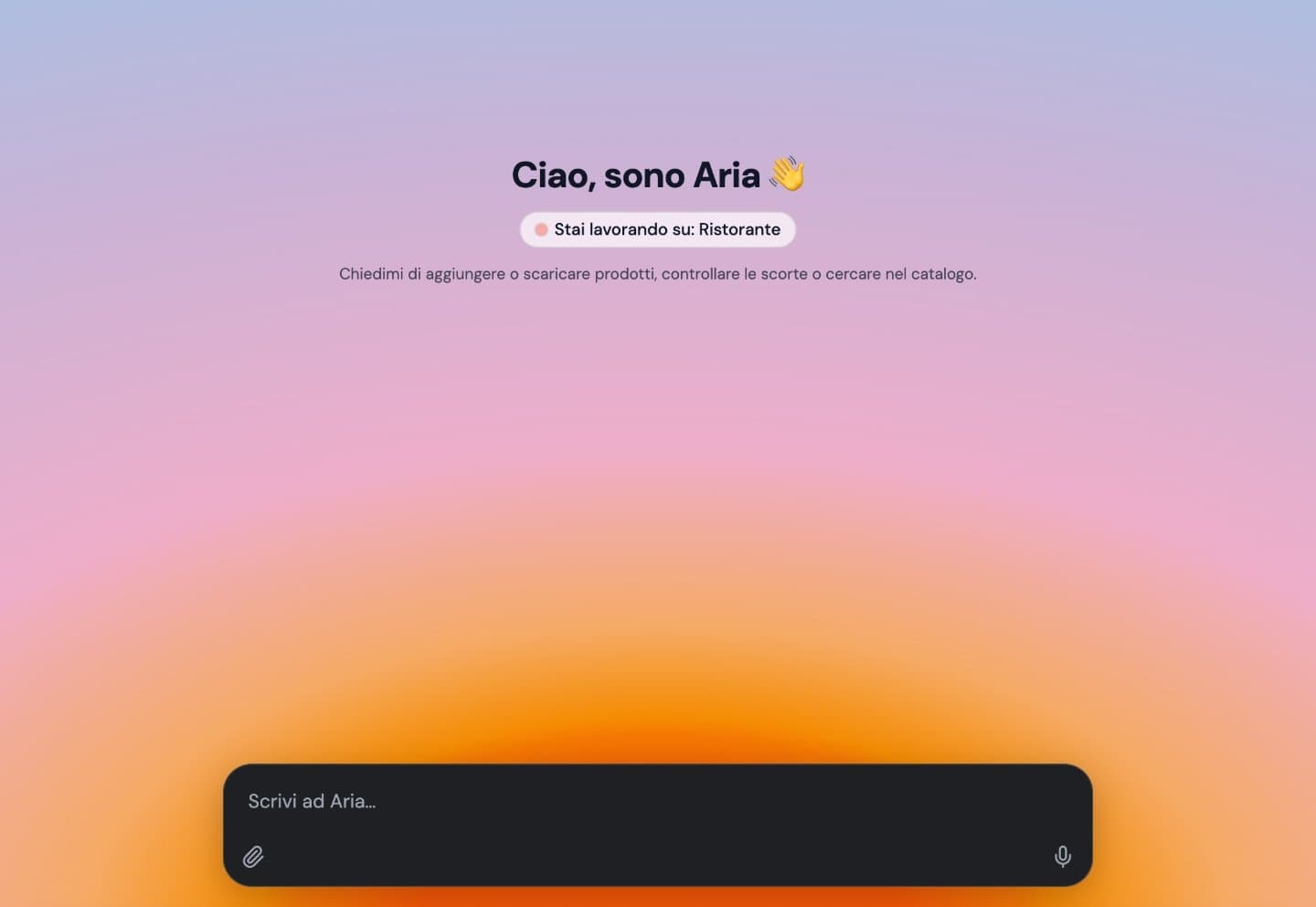
The most interesting part is Aria. In a kitchen or stockroom your hands are often busy, so typing on a tablet isn't convenient. With Aria you tap a button and speak, or type if you prefer.
You can ask Aria to add or remove products, check stock or search the catalogue. Behind the scenes:
- reasoning is handled by Claude, Anthropic's model, which understands the request and turns it into a precise action in the app;
- the voice runs on ElevenLabs, for natural, fast replies;
- the app actually performs the operation and shows the result, so staff always see what happened.
My rule: the AI must never make things up. It only works on the app's data, and every action stays visible and under control.
The tech stack
- React, Vite and TypeScript for the interface, with Tailwind and shadcn/ui for components;
- Node.js with Express for the backend and inventory logic;
- Claude API for the assistant's reasoning;
- ElevenLabs for the voice.
The result
Aria now runs the stock of 3 stores in the same group, each with its own inventory, from a single app. Switching between stores takes one click and prices always stay in sync.
What I learned
- Start from the problem, not the technology. The voice assistant works because it solves a real annoyance (busy hands), not because it looks cool.
- Data comes before AI. Without a clean catalogue and reliable price history, no assistant can give useful answers.
- Custom software adapts to people, not the other way round. That's what makes the difference compared to generic tools.
If you run a business and recognise these problems, get in touch: I'll explain how it could work for you.